Utah Mortgage Calculator

Use this free Utah mortgage calculator to estimate your monthly mortgage payments and annual amortization.

Loan details

%

Monthly payment

$2,120

at 6.93% · 30-year fixed

  • Principal & interest

    $1,585

  • Property taxes

    $375

  • Homeowners insurance

    $160

Loan amount

$240,000

Total interest paid

$330,765

Payoff date

—

YOU'RE KEEPING $12,786

$12,786

stays in your pocket

That's your total savings over 30 years at today's best rate on NerdWallet (6.93%) vs. the 7.15% national average — $36 less every month.

  • Today's best rate: 6.93%

  • Get your free rate with no credit impact

Get my rate

No impact to your credit score

Calculated payments and savings are estimates. The calculator result does not constitute an offer for a loan and will not solicit a loan offer. Savings will depend on the actual amounts and rate for which you are approved, should you choose to apply.

Getting a Mortgage in Utah

Written by 
, 
Edited by 
 and 
Last updated November 19, 2025
Real estate markets can vary dramatically by location, which is why national housing averages don’t always reflect what buyers actually pay. Housing costs are just one part of affordability, and tools like a cost of living calculator can help show how factors such as taxes, utilities, and everyday expenses differ from place to place.
Mortgage costs in Utah, the Beehive State, vary depending on where you buy. In Summit County, home to Park City and some of the state’s most expensive housing markets, the typical monthly mortgage payment for a median-priced home was $6,297 in Q1 2025, based on a median home value of $1,074,403, according to the National Association of Realtors. By comparison, the national median monthly payment was $2,120 for a median-priced single-family home valued at $402,300.
By contrast, Cache County, home to Logan and Utah State University, is more affordable. There, the typical monthly mortgage payment was $2,929 for a median-priced home valued at $499,635, reflecting more moderate home prices outside Utah’s highest-cost areas.

Utah mortgage and refinance rates today (APR)

ProductInterest rateAPR
30-year fixed-rate7.358%7.361%
20-year fixed-rate7.374%7.381%
15-year fixed-rate6.631%6.643%
7-year ARM7.625%7.312%
5-year ARM7.375%7.040%
30-year fixed-rate FHA5.453%6.193%
30-year fixed-rate VA6.685%7.032%
Data source: ©Zillow, Inc. 2006 – 2026. Use is subject to the Terms of Use

Today's rate

7.361%

30-year fixed

Today's mortgage rates in Utah are 7.361% for a 30-year fixed, 6.643% for a 15-year fixed, and 7.040% for a 5-year adjustable-rate mortgage (ARM).

Utah's first-time home buyer programs

The Utah Housing Corp., or Utah Housing, offers several loan programs to help qualified first-time home buyers get a mortgage.

Average property tax by county

Taking U.S. Census data, NerdWallet has crunched the numbers to help you understand what property tax rate you can expect to pay on your future home in Utah. Because assessed values aren't frequently updated, you may pay a higher rate at first but eventually you'll pay a similar rate.

CountyAvg. property tax rateMedian home value
Beaver County0.30%$248,200
Box Elder County0.50%$308,900
Cache County0.51%$464,700
Carbon County0.66%$176,400
Daggett County0.53%$252,400
Davis County0.55%$529,900
Duchesne County0.57%$228,600
Emery County0.59%$168,700
Garfield County0.37%$237,800
Grand County0.40%$426,800
Iron County0.47%$299,400
Juab County0.40%$322,100
Kane County0.48%$297,500
Millard County0.50%$227,000
Morgan County0.53%$556,900
Piute County0.40%$218,800
Rich County0.36%$272,900
Salt Lake County0.55%$535,800
San Juan County0.49%$177,900
Sanpete County0.50%$268,600
Sevier County0.57%$239,400
Summit County0.32%$895,100
Tooele County0.55%$454,700
Uintah County0.54%$253,100
Utah County0.45%$548,100
Wasatch County0.48%$620,800
Washington County0.46%$528,400
Wayne County0.35%$316,200
Weber County0.59%$436,600
Source: American Communities Survey 2022, U.S. Census

How to use the mortgage calculator

To use our mortgage calculator, add your details to the following fields:
1. Home price: What you're hoping to spend on a home.
2. ZIP code: The home's location.
3. Down payment: How much cash you're paying upfront towards the home's price. This calculator defaults to showing a 20% down payment, but you can adjust it up or down by changing the dollar amount or the percentage. This calculator assumes you're using a conventional loan, so it will automatically add private mortgage insurance if the down payment amount is less than 20%.
4. Loan term: The default is 30 years, but you can also choose a shorter term.
5. Interest rate: Use today's average APR, enter the rate you've been quoted or use the lowest APR NerdWallet partners are offering today.
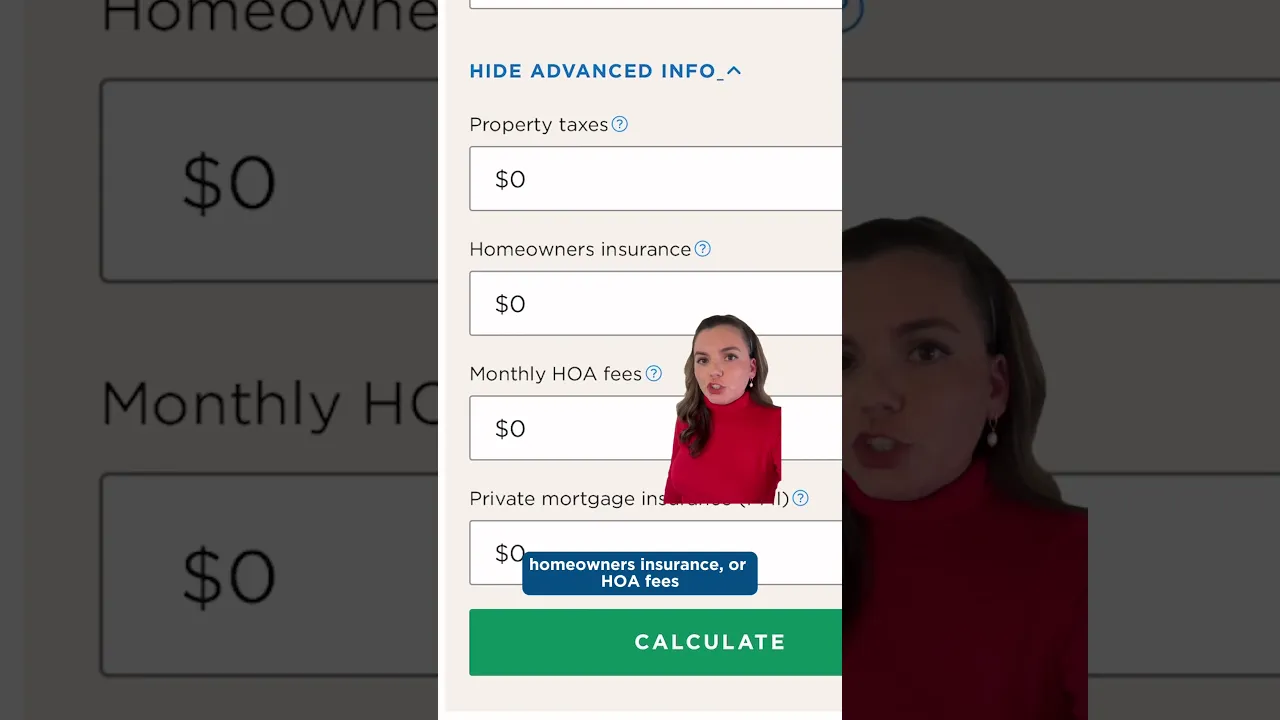
That's the least you can do. To get more accurate results, fill in the following four categories. (Estimates are fine, but this goes over how to get more specific numbers.)
6. Property taxes (per year): This is autofilled with an estimate, but property taxes vary tremendously throughout the country. Get more precise by looking up the tax rate where you're planning to buy or looking at the tax history for the home you're interested in. You can change the property tax amount by editing the dollar amount or the percentage.
7. Homeowners insurance (per year): Mortgage lenders require borrowers to have homeowners insurance. Not sure what you might pay? This calculator puts in an estimate, but you can use NerdWallet's home insurance calculator to fine-tune it. All you need to know is the property location and the rough amount you'd be looking to insure — use the home's price as a proxy.
8. HOA fees: If the home is part of a homeowners association, put the monthly dues here. (The calculator default is no HOA costs.) This is also information you can likely crib from a home's listing. One other note, if there are HOA fees but you're going to pay them directly rather than with an escrow account, you can omit them here.
9. PMI (monthly): If you've entered a down payment amount under 20%, this will autofill, since the calculator assumes you're using a conventional loan. PMI is tied to your credit score, so if you want a more accurate figure, pop over to NerdWallet's PMI calculator. If you're using a VA loan, you can zero this out, since VA loans do not require mortgage insurance. On the other hand, if you're getting an FHA loan, you'll have to pay mortgage insurance premiums regardless of your down payment amount. For more accurate payment info, use our FHA mortgage calculator.
The calculator's results will update as you adjust the numbers in these fields. The results show you the monthly payment, as well as:
  • Loan amount: How much you're actually borrowing in principal.
  • Total interest paid: How much interest you will pay over the life of the mortgage if you keep it until its term ends. (Most people sell or refinance well before that point, but it's still interesting info.)
  • Payoff date: If you kept the same loan for its entire term, here's the month and year when you'd own the home free and clear.
There's also a simple annual amortization schedule. Amortization shows how your mortgage payment changes over time. Even though the principal and interest payment doesn't change with a fixed-rate mortgage, the percentage of that payment that's going toward each component does. At the beginning of the loan, more goes toward interest; the closer to the end of the loan's term, the more of the payment goes toward principal. If you want a more detailed month-by-month look, yes, NerdWallet has an amortization calculator, too.
Video thumbnail
CONSIDERING A REFI? If you're looking to see how much you could save by refinancing your mortgage, try NerdWallet's refinance calculator.
» MORE FOR CANADIAN READERS: Canada mortgage payment calculator